
Do you know that Andong is also the mecca of Buddhism in Korea? The many beautiful temples that can be found around this region are testimony to that.


The most famous and largest is the Bongjeongsa Temple. According to legend, Monk Uisang threw a paper-made phoenix in the air from the nearby Buseoksa temple and chose the spot where it landed. to build the Bongjeongsa Temple.
But an inscription found in one of the halls, shows that the temple was actually founded by Neungin-daedeok, a disciple of Monk Uisang.


The Daeungjeon or the main temple hall, on the other hand, is from the early Joseon Dynasty era. On this site you can also find a three-story pagoda, Deokhwiru and Yosachae and several small Buddhist temples such as Yeongsanam and Chijoam.
It is rather interesting to find the Geukrakjeon from the Goryeo Dynasty and Daeungjeon from the Joseon Dynasty, standing side by side. It’s entirely two different types of architecture altogether inside the buildings. There is also a tree , with the complete collection of Buddhist Sutras, Laws and Treatises amongst others.

Yeongsanam, which is at the back of the Bongjeongsa Temple was made famous by the film 'Why has Buddhist-dharma left for the east? .

Icheondong Seokbulsang (Buddhist stone statue).
Maaekseobulsang means a huge statue. This Buddhist statue stands 12.38 meters tall. After the Jebiwan Temple was built near the statue, it has been dubbed as “Jebiwan Seokbul.”
The body of the large stone Buddha has been carved into the rock. The statue is in the style of Koryeo (AD 918-1392) , with distinctive contouring. This unique style is indicative of those prevalent during the 11th Century.
The following temples are some of the other temples that can be found in Andong.

Kaemoksa Temple
Legend says that this temple was originally called Heungguksa Temple. In those days, there were quite a large number of blind people in Andong. But when its name was changed to Kaemoksa (opening eyes)Temple, blind people reportedly regained their eyesight here.
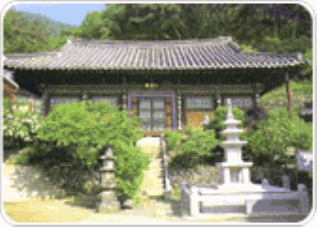
Gwangheungsa Temple
This temple, constructed by Monk Uisang, was once the largest temple in Andong. Nowadays, there is only Buddha to worship at Eunggingak, which was an additional temple to Gwanghungsa.

Yongdamsa Temple
This temple, constructed by Monk Uisang during the reign of King Shinmun of the Shilla Dynasty, is located at the foot of Mt. Hwangak.

Bonghwangsa Temple
This is the largest temple in eastern Andong. There is a legend that its colors were painted by a Chinese Phoenix.
 The Ocheon Relics Site (Village)
 The Ye-an branch of the Gwangsan Kim clan’s founder, Sir Hyo-ro Kim created this village. Descendents of the family have resided in the village ever since. In 1974, when the Andong Dam was constructed, the village was moved from Ye-an Myeon, Andong to Waryong Myeon, Andong in its original form. Located between these two points are the designated national cultural heritage sites of Takcheongjeong Pavilion and Hujodang Annexed House.
Takcheongjeong Pavilion
The pavilion was constructed in 1541 by the Ye-an branch of the head of Gwangsan Kim clan. The pavilion is unique from others in that it is rather stately. It remains a highly treasured and important cultural landmark. During the Joseon Dynasty, noted calligrapher Ho Han named the pavilion 'Takcheongjeong.'


Hujodang Annexed House
This house belongs to the head residence of the Ye-an branch of the Gwangsan Kim clan. The exact age of the house in unknown but it was built by Bupil Kim. This structure was built separately from the main house. The annexed living quarters were divided into interior and exterior areas. The exterior quarters were used by the male head of the household as a place for relaxation and social gatherings. The interior quarters were used as a place for elderly women or girls of marriageable age to stay.


The rock filled dam is 612 meters long and 83 meters high, and was built in 1976. The resulting Andong Lake has many fishing spots and picnic areas.
Below the dam, a smaller lake formed by the minor Pojo Dam creates a lovely setting for the Andong Folk Museum, Andong Folk Village and a lake-side park.
Before I tell you about the Andong Folk Village I would like to add something about the Hahoe Folk Village (my previous post), that I had left out and which I would like to mention here.
Hahoe's history dates back to the late Koryo Period and unlike other villages, both the upper class and the commoners lived together in the same village. But the houses of the upper class were located in the village center, whereas those of the lower class were built on the outside. Another prominent feature is that the houses face in all directions from the center whereas most houses in other villages all face south.


Here’s a tip for you if you are going to stay in Hahoe. Want to go on a picnic? Across the river from Hahoe, Puyongdae offers a picturesque setting for a picnic. The sandy beach usually has fewer tourists than the rest of the village. This is what I call the “off the beaten track trail.”


And now for the Andong Folk Village. When the Andong Dam was built in 1976, the resulting lake would have submerged many cultural relics. Rather than lose them forever, they were removed and the Andong Folk Village was specially created to house them within the Andong Folk Museum's outdoor space. The village boasts of 14 different traditional buildings and structures, many of which serve as traditional restaurants highlighting the local cuisine. Also to be found here is the Andong Folk Museum.
At the present entrance to the folk village are two large totem poles (Changseung) with comical carvings of people's faces. Located next to the gate is a monument inscribed with the poem of famous Andong poet and democracy activist, Yuk-sa Lee His most well-known piece of work 'gwangya' (wild plain) is inscribed in the monument.
A hill situated behind the monument leads to the filming location of the popular drama 'Taejo Wanggeon', based on the life of King Taejo. Due to its historical background, the Andong area has become a popular backdrop for numerous television dramas. When King Taejo founded the Goryeo Dynasty the local village leaders and kin supported his leadership, strengthening his influence throughout the Andong region.


Who would have thought that there are totem poles in Korea, the USA would be the most likely place to find them. Well this park, the Jangseong Park is full of totem poles. Unlike the scary faces traditionally carved on changseung, many of the examples in this park have very humorous faces and poses.
Traditionally, they were used to guard the local village, temple, or castle from evil spirits, to pray for good harvests, or used as general landmarks. The various regions of Korea developed their own shapes and characteristics, and they are known by many other names: changseong, changshin, peoksu, peokshi, peobsu, susari, tolmiruk, tangsan halaboji, sumak, sari, and many others.
Sot'dae are sculptured wooden birds perched atop long poles. Often found outside villages with changseung, they are also used to ward off evil spirits, ghosts, and disease. After agricultural festivals, villagers would place offerings of straw, fish, paper, jujubes, thread, and other items to pray for good luck and plentiful harvests.

The indoor museum is segmented into three exhibit halls. At Exhibit Hall 1, the process of going from the birth of a baby to childhood is displayed. At Exhibit Hall 2, the process of becoming an adult to the rituals of death and funeral is displayed. At Exhibit Hall 3, the daily life and traditional games are displayed in small models. There is also a video for visuals. After you are through with the indoor exhibits, head outside for the outdoor exhibits comprising of a park complex, made up of folk houses and other cultural assets that were moved to this site.

In Dongbu-dong, there is a 8.35 m high brick pagoda from the Unified Silla Kingdom Period Each brick is 27.5 cm long, 6 cm thick and 12.5 cm wide In the past, it was 7 stories high. In 1598, during the Japanese Invasion of Korea, the top motif was destroyed and the structure was further damaged during the Korean War. The pagoda was repaired in 1962. Rumour has it that the pagoda was once located inside the old Beomnimsa Temple. The Dangganjiju, which is located 5 m west from the pagoda, supports this story. One can see the small place to keep sculptures of the god on each floor.
From the south , one can see the beautiful remnants of the In Wang-sang statue. It is located on the left side of an open space at the end of the parking lot at Andong Train Station.


Andong Soju Museum.
The traditional rice liquor from Andong is so famous that it was designated an intangible cultural asset of the province in 1987. Located on the grounds of the still-operational Andong Soju Brewery, this museum shows how the alcohol is being made. Andong soju is 45% alcohol, yet one doesn’t suffer from a hangover the following day. For those of you who want to know how Soju tastes like, it is sold here at wholesale prices.
Queen Elizabeth's memorable birthday visit to the Andong area included a visit to this museum. Visitors can view a special area that was used to celebrate the queen’s birthday; the room has been kept in the same condition as it was then when she was there.

Goseongissi Tapdongpa Jongtaek (Gosoeng Lee head family estate, is the head house in the family line of the Goseong Lee noble family. The eldest grandson of the family is still alive today. Constructed in 1685, this house has all of the beautiful features that are representative of Joseon architecture. After this period, additions to the structures were added periodically. The pavilion was constructed in 1775. This site was the original spot of the Silla Dynasty's Beoheungsa Temple. Sinse-Dong Chilcheung Jeontap(seven-storey pagoda), is located in front of the house.

The Sinsedong 7 stories Brick Pagoda is Korea's oldest and largest stone pagoda. The pagoda was originally built at Beobheungsa Temple during the eighth century of the United Silla Kingdom and is the only remaining relic from the temple.
The pagoda is presently located on the estate of the head house of the Goseong Lee family. The ornamental top portion of the pagoda has been totally lost, but the lower tiered portions are intact with beautiful carvings of Buddhist tutelary deity. Traces of tiled roof were found on each story of the tower. In the past, it was 7 stories high. In 1598, during the Japanese Invasion of Korea, the top motif was destroyed and the structure was further damaged during the Korean War. The pagoda was repaired in 1962.

Imcheonggak was built as a home during the Joseon Dynasty because of one aristocratic family's love for the scenic beauty of the area. The most famous structure on this property is the annexed pavilion. Thankfully this structure was untouched during the Japanese Invasion An autograph of the famous Confucius scholar, Lee Hwang can be found hanging outside the pavilion. Imcheonggak is designated Treasure No.182.


How can I forget to mention about the Jirye Art Village and Jeonju Ryussi-musiljongtaek (Ryu noble family’s estate).where you can find one of the best guest house accommodations in Korea? If you are a nature lover you’re bound to fall in love with the Jirye Art Village even more. Jirye Artist Town is a 45-minute drive mostly on an unpaved road east of Andong City in Kyongsang-pukto. Overlooking the Naktong River, the town is one of the very few ecological habitats to be found in Korea. Here you can experience a genuine taste of traditional Korean living culture in close harmony with nature.
The “birth of the town” came about when a cluster of traditional Korean houses belonging to the "Kim" clan of Uisong in Kyonsang-pukto, was in danger of being submerged in the resulting lake due to the construction of the Andong dam. Built in 1663, the traditional Korean houses were then relocated here at the present site. Their move to the present location was the work of Kim Won-gil, who gave up his faculty seat at Andong University to save them. Luckily traditional Korean houses can be easily dissembled and re-assembled. Even then, it was a strenuous struggle for five long years before the culturally rich houses were relocated to its present site. Thanks to Kim Won-gil and his foresight in wanting to create this cultural space for artists and where foreigners can get in touch with the genuine aspects of traditional Korean culture that we are able to enjoy the fruits of his labor today. Here artists can pursue creative works and there is also a Traditional Experience Center where you can have a hands-on experience of Korean culture. Originally, this was the home of scholar Kim Bang-geol, a civil minister of Jichon during the reign of King Sukjong of the Joseon Dynasty.
Three cultural assets, the Jisan Seodang (elementary school), the Jichonjongtaek (Head family house) and the Jichonjecheong (Shrine) were among the many cultural assets that were relocated here.
Jisan Seodang was established in 1800, in remembrance of the achievements of Kim Bang-Geol, as a place for the future generations to study. Jichonjongtaek is the head house of Kim Banggeol's Family. Established in 1712 at his own request, Jichonjecheong was a shrine where ancestral worship was held and which has been used as an auditorium. Beyond the tile-roofed houses, low mountains surround Jirye Artists' Colony, and there is a lake down from the village. If you pass a tall gate there is a large square and straight ahead is the main building, the schoolhouse is on the right and a shrine on the left hill. When you reserve accommodation at Jirye Art Village, pick up service is available from Andong Station or Andong Terminal.
And with this I’ll end today’s post. Till next time annyeong haseyo! Don’t forget to stop by again.


